Instead of spinning another tale of tournament etiquette gone a wry, let me describe the situation as neutral as possible. Please help me to deal with situations like this better in the future.
We, my opponent and I, are on the bottom of turn 6. My opponent has pretty clearly won on all 3 of the objectives. We are, however, unclear on the end time of this round, wondering if there is enough time left for a turn 7. The tournament packet stated all games should be at least 6 turns if possible, with a 7th turn on a 4+, don’t start a turn if you have less than 10 minutes left. My opponent is about to move his last unit, a Chimera with a scoring unit inside, and about to end his turn 6. He makes a statement to the affect that he needs to know if the game will end right now or if we will have an next turn, because that will determine how he will move this last tank. He freezes the game, sends someone to go find the T.O.
Several minutes go by (three to be exact). The gentleman comes back and states we have 9 minutes left. I insist on a turn 7 on principle. I take my last model, shoot my bolt, roll and pen, then roll a 1 on damage chart, fail to take out a Storm raven. He kills my last model and wins full points.
Okay, forget being neutral.
Different game, Different tournament: My opponent has a lot of infiltrating troops; I roll my non preferred wave. All objectives are placed in cover. My opponent holds all objectives on turn 1. I hide and cower in various corners, till I finally get the strength to take him on at the bottom of turn 4. I still have units coming in, about one-fourth of my army. My opponent informs me that we have 20 minutes left, there is no way I can win, good game. The tournament rules were: play 6 rounds; get a turn 7 on a 4+, only start a round if you have time to finish.
I insist on starting a round 5 and after a little arguing call over a T.O. We get a non committal answer, we start playing. We actually played 2 turns and finished turn 6 with a minute or so to spare, I about tabled my opponent, at the end of the game I had full points. Yelling and screaming, fist balling in response to my insistence. I did get an apology at the end. Both of us had a 1-2 record in a 5 round battle point tournament at this point, so both not even close to being contenders.
I realize I have time as a pet peeve of mine, but am I being unreasonable? I play 2000-point games at our club easily in less than 2 hours. My army (Daemons) does nothing during the deployment zone, I rarely bring shooting elements, I rarely have my whole army on the board at anyone time.
Let me know what you think I should do differently….

Monday, June 27, 2011

Tuesday, June 21, 2011
Tales of nice dice and killin’ fury little mice.
You can skip to the last paragraph if you know all about dice and shenanigans.
Articles have been done, redone and outdone on cheating or the perception of cheating with dice. A few simple internet searches will easily give you more material than you would probably want to research. Yet every tournament I see similar shenanigans. Now I am not accusing any of my opponents or any participants, in the last tournament I played, of cheating. I am saying that some assisted in causing the perception of cheating or more precisely did thing that caused the perception of cheating to not be debunked. Hmmm, sounds overly wordy or complicated. Let me make a little list to be clearer.
If you roll a specific set of dice only when you need to roll high, such as leaderships and morale, you create the perception of cheating.
If you paid more for your dice than you did for your custom Forgeworld Landraider painted by Baraccass from http://www.wargamerhub.com (how’s that for product placement), your opponent might think you are up to something.
If you pick up the good dice when rolling a large number of them, instead of the ones and other failed dice, your opponent is going to raise an eye brow.
If you use small tiny dice that have odd hard to see paint schemes like black pips on grey/black swirl dice, your opponent might have to borrow my glasses.
If you load a bunch of dice on your hand and just drop them on the table, your opponent might have the urge to shake the table.
If all your dice are white with black pips and you declare that the alabaster ones are the melta, the ivory the plasma gun, the milky one is the storm bolter, the pale one is the heavy stuber and all the white ones are not worth mentioning, your opponent might think he is colour blind and need a ref.
If you use casino dice, incase you missed a previous bullet, your opponent certainly will consider the fact that you might just be cheating.
If you do funny things with your hand, like rolling dice of your fingers, two at a time, always with certain pips up, your opponent will ask to talk to a pit boss,…err never mind.
The short of it is, if you do certain things that are questionable, even though in most cases you are not even thinking about cheating, you are creating a perception that cheating is going on. Why alienate players our community is small enough and we are after all playing with toy soldiers. You will not gain the respect of your fellow peers and the admiration of mighty fine women, nor will the prize pot buy you a fancy sports car. You will, however, end up with a reputation that people will talk about for years.
Now to the point of me writing this in the first place, for the people that stayed with me the whole article and people that skipped ahead to this point. My game 5 at endless, in Raleigh NC, saw me rolling hot, maybe even white hot. My opponent was rolling 1’s like he needed to win a Yahtzee tournament. After a bit of grumbling, my opponent asked if we could share my dice for the rest of the game. I found that to be a unique and great solution. Instead of calling me a cheater, or faulting me for creating the perception of cheating, he presented a solution that satisfied both our interests in the game. I piled my dice in the center, and we really enjoyed the rest of the game. His dice luck did not, regrettably improve by the way. You may say this only worked because it was the last game, and we were both not in the running, but I would have gladly used this same solution with the player I played with his big bag of casino dice. Props to my opponent for finding a table side solution, without causing hate and discontent.
Articles have been done, redone and outdone on cheating or the perception of cheating with dice. A few simple internet searches will easily give you more material than you would probably want to research. Yet every tournament I see similar shenanigans. Now I am not accusing any of my opponents or any participants, in the last tournament I played, of cheating. I am saying that some assisted in causing the perception of cheating or more precisely did thing that caused the perception of cheating to not be debunked. Hmmm, sounds overly wordy or complicated. Let me make a little list to be clearer.
If you roll a specific set of dice only when you need to roll high, such as leaderships and morale, you create the perception of cheating.
If you paid more for your dice than you did for your custom Forgeworld Landraider painted by Baraccass from http://www.wargamerhub.com (how’s that for product placement), your opponent might think you are up to something.
If you pick up the good dice when rolling a large number of them, instead of the ones and other failed dice, your opponent is going to raise an eye brow.
If you use small tiny dice that have odd hard to see paint schemes like black pips on grey/black swirl dice, your opponent might have to borrow my glasses.
If you load a bunch of dice on your hand and just drop them on the table, your opponent might have the urge to shake the table.
If all your dice are white with black pips and you declare that the alabaster ones are the melta, the ivory the plasma gun, the milky one is the storm bolter, the pale one is the heavy stuber and all the white ones are not worth mentioning, your opponent might think he is colour blind and need a ref.
If you use casino dice, incase you missed a previous bullet, your opponent certainly will consider the fact that you might just be cheating.
If you do funny things with your hand, like rolling dice of your fingers, two at a time, always with certain pips up, your opponent will ask to talk to a pit boss,…err never mind.
The short of it is, if you do certain things that are questionable, even though in most cases you are not even thinking about cheating, you are creating a perception that cheating is going on. Why alienate players our community is small enough and we are after all playing with toy soldiers. You will not gain the respect of your fellow peers and the admiration of mighty fine women, nor will the prize pot buy you a fancy sports car. You will, however, end up with a reputation that people will talk about for years.
Now to the point of me writing this in the first place, for the people that stayed with me the whole article and people that skipped ahead to this point. My game 5 at endless, in Raleigh NC, saw me rolling hot, maybe even white hot. My opponent was rolling 1’s like he needed to win a Yahtzee tournament. After a bit of grumbling, my opponent asked if we could share my dice for the rest of the game. I found that to be a unique and great solution. Instead of calling me a cheater, or faulting me for creating the perception of cheating, he presented a solution that satisfied both our interests in the game. I piled my dice in the center, and we really enjoyed the rest of the game. His dice luck did not, regrettably improve by the way. You may say this only worked because it was the last game, and we were both not in the running, but I would have gladly used this same solution with the player I played with his big bag of casino dice. Props to my opponent for finding a table side solution, without causing hate and discontent.
Monday, June 6, 2011
Balanced versus Unbalanced Part 3

So, in the last article, I did an analysis of an unbalanced list versus a balanced list and their respective, projected performance across rounds of a win/loss tournament. By looking at the analysis, you would think that there never is a reason to take a balanced list to a tournament. However, as you will note, I also noted that as the percentages changed, so too did the results. The reason is that our study was completely correct, but these changes in the effectiveness of each list, especially those that seemingly approached a balanced list slowing down in performance showed a clear problem with the entire study.
The real reason why our unbalanced lists keep seeming to outperform our balanced lists in these examinations is not because of some hidden truth. It’s actually a good bit simpler than that. The real reason is that, statistically, the unbalanced lists we have been examining are just flat BETTER than our balanced list.
How so? Are you saying that somehow our unbalanced list is better than a balanced list? No. What I’m saying is that our assumptions about how an unbalanced list and a balanced list, using our previous examples, is fundamentally flawed because we are comparing a jet plane to a bi-plane.
The reason why we could see this happening was that as we change the win percentages on our unbalanced list, the rate at which they would outperform the balanced list also changed. This was clearly indicative that not all unbalanced lists or equal, and indeed, it was also clearly shown that the unbalanced list was not equal to the balanced list in terms of quality as they began to approach each other.
As was pointed out in the comments of the previous post, statisticians use a concept called “expected return” to describe what the expected result of a scenario will be in the long term. For example, we all know that a coin has a 50/50 chance to land on heads or tails. Thus, our expected return of Heads when flipping a coin is 50%.
Likewise, our balanced list has an expected return of 50%, being that is has a 50/50 chance of winning any game. However, our list that would win 70% of the time versus 70% of opponents and 30% of the time versus 30% of opponents “appear” to be a good logical comparison, but it really isn’t. The truth is, the expected return of “WINS” for that list is actually (0.7 * 0.7) + (0.3 * 0.3). Thus, the expected return from this list is actually 58% wins and 42% losses. The reason why it is outperforming our balanced list is simply because it’s a better list! It has nothing to do with the balanced or unbalanced nature of the lists. If you compare two lists with an equal expected return, you will find out that the results vary as the round go up as to which list is better but actually tends to favor the balanced list. The truth is, in the long run, they are probably fairly equal.
So, what you are saying is that, this is a sham? No, what I’m saying is that the problem is that we are so focused on balanced versus unbalanced in this discussion when what we should be focused on is the concept of expected return. (Congrats to the commenter from last post for figuring this out early!) The real truth is, balanced or not, it’s the expected performance of the list which is what is going to carry the day across many rounds of tournaments.
So, how is this useful? In some ways it really isn’t which is in and of itself is a useful result. As we said last time, at the end of the day, any result we would come up with would be shaky at best, and what we have discovered is that the assumption about making an arbitrary comparison between what seems like an unbalanced list versus a balanced one is not what we need to do doing. If you want to know if a more balanced list performs better or worse than a more unbalanced list, the way to do that really is as simply as playing a lot of games with it and seeing which one wins more.
The reason why this is true is the only way you can even start to gather data about the overall effectiveness of the list is to play it. Then, the better list will be the one with the highest expected return against across a variety of games.
The reality is, at least in terms of this discussion, a better list is simply a better list.
The next thing to discover will be if two lists which have equivalent expected win rates but different unbalances will perform the same, better, or worse. Evidence so far supports that as the rounds go on, the lists which approach more even percentages tend to perform better.
Wednesday, June 1, 2011
To Balance Your List or Not To Balance Your List?


In the context of this thought experiment, the term "balanced" means "equal chance to beat all types of lists". Thus, the perfectly balanced list means that it has a 50/50 shot of winning every game it plays, versus 100% of all other lists, assuming all other things being equal.
Thus, an unbalanced list must be a list which has an uneven chance of beating some lists and losing to others. For example, you might tailor a list to win a high percentage of the time versus most other kinds of lists you expect to face but expose weaknesses to a lesser percentage of lists. For example, an unbalanced list might be a list which wins 70/30 of the time versus 70% of other lists and only 30/70 of the time versus the remaining 30% of lists.
Here's a more concrete and less math blah example! Let's say you come up with a killer Tyranid list that rocks most Marine lists provided they don't have Land Raiders in it. If we could somehow calculate the number of Marine lists without Land Raiders and came up to 80%, and your Tyranid list wins 80% of the time versus Marine lists without Land Raiders, we can say that your list wins 80/20 versus 80%. If your Tyranid list only wins 10% of the time if the Marine list contains Land Raiders, your list has a 10/90 versus the remaining 10%.
Obviously, an unbalanced list will perform better with a higher win percentage versus a higher percentage of armies and a lower losing potential versus the lowest percentage of armies.
There's so much to investigate on this topic because the notion is exciting. Keep in mind though that all of these numbers, at the end of the day, are mostly bogus. I mean, seriously. How can we calculate your "win %" with "all things being equal" versus some arbitrary "percentage" of lists out there. We can't, but you can make a serious go of it. You could look at lists brought to tournaments in the last year, play against them with someone about equal skill as you, several times each, and get a rudimentary percentage. It won't be perfect, but it's better than nothing. In any case, I just wanted to come right out and say, at the end of the day, any results we come to will be shaky at best!
So, in the previous article I showed that a list with a high percentage chance to win versus a high percentage of armies, and a lower percentage chance to win versus a low percentage of armies actually performs better in a 4 round tournament than a "balanced" list most of the time.
The next thing I wanted to know was if common wisdom is right... shouldn't the more rounds you play in a tournament mean the balanced list does better? Turns out, common wisdom is wrong. Not just wrong, but completely wrong. Indeed, the numbers show us that the more rounds you play, the more likely the unbalanced list is to outperform the balanced list.
Here's some numbers for you to chew on.
List A)
Let's assume that List A has a 70% chance of beating 70% of all lists. It has a 30% chance of beating 30% of the remaining lists. (Also seen as 70/30 V 70% and 30/70 V 30%)
List B)
Let's assume that List B is a "balanced" list and has a 50% chance of beating 100% of all other lists. (Also seen as 50/50 V 100%)
Assuming Win/Loss Tournaments. Also, assuming that a Positive (+) matchup for A is one of the 70% of the lists A does well against. A Negative (-) matchup for A is one of the 30% of the lists A does not do well against most of the time.
2 Round Tournament:
A) 49% (2+) : 49% to win.
42% (1+/1-) : 21% to win.
9% (2-) : 9% to win
B) 25% to win (0.5 * 0.5)
List A outperforms List B 49% of the time. Thus, List B is a better choice for a 2 Round Tournament.
4 Round Tournament:
A) 24% (4+) : 24% to win
41% (3+/1-) : 10% to win.
26% (2+/2-) : 4% to win
8% (1+/3-) : 2% to win
1% (4-) : 1% to win
B) 6% to win
List A outperforms List B 65% of the time. Thus, List A is a better choice for a 4 Round Tournament.
6 Round Tournament:
A) 12% (6+) : 12% to win.
30% (5+/1-) : 5% to win.
32% (4+/2-) : 2% to win
18% (3+/3-) : 1% to win
6% (2+/4-) : 0% to win
1% (1+/5-) : 0% to win
0% (6-) : 0% to win.
B) 1.5% to win.
List A outperforms List B 74% of the time. Thus, List A is a better choice for a 6 Round Tournament.
8 Round Tournament:
A) 6% (8+) : 6% to win.
20% (7+/1-) : 2.5% to win
30% (6+/2-) : 1.5% to win.
25% (5+/3-) : 0.5% to win.
14% (4+/4-) : 0.2% to win.
5% (3+/5-) : 0% to win.
1% (2+/6-): 0% to win.
0% (1+/7-) : 0% to win
0% (8-) : 0% to win.
B) 0.4% to win
List A outperforms list B 81% of the time. Thus, List A is better for an 8 Round Tournament.
Seeing a pattern? You should be noting that not only is A more likely to outperform B the higher the rounds go, the % by which A is more likely to outperform B goes up.
So, I did a little study after realizing that. What about lists that are closer to balanced or further away? Well, it ended up like this:

The Gray Line represents the balanced list. As the rounds go up, it begins to under-perform versus unbalanced lists.
The Red Line represents an unbalanced list with a very high win % versus a very high % of lists. and a low loss % versus a low % of lists.
The Green and Blue lines represent unbalanced lists with progressively lower win % versus lower % of lists OR higher loss % versus a higher % of lists, respectively.
The way it works is just like you would expect. The better your unbalanced list is versus most other lists, the better it will do. The way that is measured in this experiment is by the "SPEED" in which it will start to outperform the balanced list where the "SPEED" is the number of rounds in the tournament.
So, a better performing unbalanced list will start to outperform the balanced list in less rounds. A lesser performing unbalanced list takes more rounds to outperform the balanced list.
Eventually, though, all unbalanced lists will outperform the balanced and approach 100% of the time as tournament rounds go up.
Friday, May 27, 2011

I was reading a BLOG post today : http://nike40k.blogspot.com/2011/05/theory-luck-vs-skill-vs-your-mom.html ... And it got me thinking.
The part that interested me was the mental exercise of examining what happens when you take a list that is great against most armies but not so great against a few to a tournament. As expressed in this article, common wisdom would tell us that you will do great in tournaments with only a few rounds, but in tournaments with more rounds, your odds of winning the whole thing should go down.
Let me be a little more clear. Let’s take a win/loss tournament as an example. That means that you win the tournament by winning every game you play. Now, let’s say you take some army that you developed that wins 80% of its games versus most armies, but there are just a few match-ups where you only win 20% of your games. The foil (opposite) of this is the balanced army. The concept here is that you have any army where it has a 50% chance of winning every game it plays.
First and foremost, I don’t believe there is such an army that is so well balanced that it has an even chance against every other list in the game given two equally skilled players. Some people do believe this, but I always believe that any given army has some match-ups where it will excel and some where it will perform less admirably. I definitely do not believe there is such a list that wins more than 50% of its games versus every army. That would mean you have the SUPER list, the best list possible. Why? Logic tells us that if your list performs at above 50% than ALL OTHER LISTS, there is no other list that can be better than it! Gotta love it!
Okay, back on track. Here are the questions I want to examine:
- First, is it better to take a list that performs well against most match-ups but suffers against a few, specific match-ups to a tournament and gamble that you don’t run into your bad match-up?
- Second, is it actually better to take a balanced list that has a 50% chance against any other list and rely on your luck and player skill to carry the day?
- Third, does the answer to the first two questions change depending on how many rounds are in our win/loss tournament?
Now, you know, people don’t publish papers to simply express boring results. I wouldn’t even be writing this if I didn’t think there was something surprising about to happen. Common wisdom tells us that “balanced lists are the way to go!”, but are they really?
Let’s set up a scenario to examine.
First, let’s pretend that I have a list that wins 80% of its games versus 75% of all the lists out there. However, it only wins 20% of its games versus 25% of the remaining lists. This means that if I take this list to a tournament and only run into the 75% of the lists I’m good against, I should rock this thing. However, if I run into one of the 25% of the other lists that kick my butt, I’m in trouble!
Now, let’s pretend that my buddy built a list that functions at a 50/50 versus 100% of all lists.
WHO IS MORE LIKELY TO WIN A 4 ROUND WIN/LOSS TOURNAMENT?
My Buddy has: 0.5 * 0.5 * 0.5 * 0.5 = 6.25% chance to win the whole thing. Assuming all things are equal meaning player skill, luck, etc. Not very good is it? He only has a 50% chance to win each game. And we all know that rolling a 4+ 4 times in a row without failing is pretty darn difficult to do!
Now, let’s look at my list!
First, I have a 32% chance that all 4 of my opponents will have a list that my list kicks butt against. How? Because 0.75 is my chance to get an opponent I’m good against and 0.75 * 0.75 * 0.75 * 0.75 = 0.32 (approximately).
My overall odds of winning the tournament if I get all 4 of my opponents being favorable match-ups is: 41% WOAH! That’s WAY better than my buddy who only had a 6.25% chance! The problem is, I’ve only got a 32% chance of this occurring… a little confusing but follow along!
Carrying on, I have a 42% chance of EXACTLY ONE of my opponents being a bad match-up for me. That’s not good! 42% is more likely than my 32% chance to get all 4 of my opponents being favorable. Surely, if this scenario happens, I’ll have a worse chance of winning the tournament than my buddy?
Actually, your odds of winning this event are: 10%.
SAY WHAT? Even with a bad match-up, I’m still more likely to win the tournament than my buddy with the evenly balanced match-ups. So 32% + 42% or 74% !!!!! of the time, I have better odds of winning than my buddy does.
Okay, what about the dreaded scenario of running into 2 bad match-up? 21% chance of that happening. Turns out, I only have a 2.5% chance of winning. Now, my buddy was better off with his list than I was with mine. However, 74% of the time, or the amount of times you roll hits with a Twin-Linked Lascannon on a Vendetta, I would be better off with my list.
There’s more analysis to take place. For starters, we haven’t answered question #3 yet. I also want to discuss how things change when the numbers change.
Stay tuned for the next article.
Thursday, May 26, 2011
Standard List Names and Templates
Hi all,
For our Game Plan segment on the podcast, I'm trying to compile a list of the "this is what I usually see run at a tournament" lists for each codex along with their names. For example, Deathwing, Leaf Blower, DoA List, etc.
Included with the name will be an example of that list. This is actually kind of a fun exercise, and I'm looking for any help in buidling it. If you would like to contribute a list, go ahead and post it, and I can add it's name to the master list.
Thanks!
Monday, May 23, 2011
Is Internet Redemption Possible?
Anyone who has ever played a multiplayer online game knows there are lots of people who don’t know how to act. People hiding behind their assumed anonymity doing things the majority of us would never think of doing to others in real life, even less likely in person. We have a whole generation who haven’t (and probably won’t) learn basic skills such as getting along with others in a game, abiding by the rules and playing nice with others. As a kid playing in the neighborhood you had to get along. Take your ball home too often, and you were left with no one to play with. In online multiplayer games getting alienated from a play group is not a big deal, either find a new group among the thousands of people playing, or better yet, create a new account.
With 40K most of us have limited opportunities to play; we are either limited by the amount of local players, or limited locations offering a place to play. We are therefore still bound by the old fashion playground rules, mess up too often, get labeled as ‘that guy’ and sit at your local store with your mini’s on a table watching other people have fun. On the many forums and blogs like BellOfLostSouls, people can behave as badly as they want to be. Hundreds of thousands of threads and comments make statements and degrade people in such a way that would get you physically hurt if stated in person.
Some podcasts act in similar fashion. Calling people douche bags, calling people out for real or perceived cheating, making statements about companies of individuals, often without doing any research or providing sources of information. As a podcast, we have in the past struggled with striking a balance between our perceived truths of a situation and alienating people in our limited sized community. Like it or not, the amount of people playing your favorite game in any location is severally limited. Even relocation across the country may still not save you from your reputation.
I usually get disgusted with accusations of cheating, I actually had to turn off my screen and go for a walk after watching the first 5 minutes of a 30 minute YouTube video on cheating at a large event. It had my blood boiling. I have limited patience for shenanigans at tournaments. Regardless of what people may think, I am not going to tournaments to ‘win-it-all’. I go to tournaments so I can play other people outside of my regular gaming group. I am really looking forward to going to the Nova and being placed in a decent group the second day, looking forward to some fun but challenging games. While I will not tolerate cheating and other bad behavior, I would not call out people on the podcast, certainly not by their real name. This finally leads me to what I am getting at, and the main reason for writing.
Tony K. made a mistake at the Nova Open last year. He was 3 points over. He brought it to the attention of the TO the same weekend of the event. The tournament organizer (Mike Brandt), and the other ‘top competitors’ (including Stelek) chose not to sanction him for his event. If you want a dissenting opinion, check out TastyTaste at bloodofkittens.com. We have had 8 months since that event, in that time we have seen several podcasts and countless forums and blogs badmouthing a minor, calling him every name under the sun. Neil and I had the pleasure of playing one of the brothers each at the last Nova. I have to say we were both impressed with their abilities and manners. I hope my little sons grow up to be gamers like them one day.
Tony goes on to win Adepticon and got himself selected to Team America. Not a single shred of evidence suggested that his 8-0 record was tainted by anything but good sportsmanship and courteous behavior. Several podcasts and other internet voices still cast doubt on his performance. Is it really possible that he could, by luck alone, have won Nova with a perfect record and then Adepticon eight to zero? Sure. But is it may be possible that some adults are having a problem controlling their little green monsters? Are we really disrespecting Tony’s capable opponents as a bunch of losers? You can watch some of Tony’s abilities on the excellent coverage the Independent Characters provided. I for one am looking forward to hearing about his exploits among the rest of Team America at the ETC. I for one cannot think of a better person to represent a typical American gamer to the rest of the field in Europe.
On the flip side, how many chances do we, or should we give some people. Is getting banned from stores in North Carolina and Florida enough? Is public intoxication and public bragging about it enough? How many times does an individual need to get mentioned with questionable play ethics on BloodOfKittens? How far are we going to let individuals like this bend rules, forget rules, model to advantage and pull other shenanigans? How do we fix this situation? I am not sure I have any answers. There is minimal communication between event organizers. It is hard enough for me to get information of events happening, let alone have them talk to each other about misbehaving players. If people knew that their behavior at one event would carry over to the next event, would they behave better? While I do not have answers, I think a setup like the NovaOpen has the potential to fix a lot of problems. The separation into smaller sub tournaments the second day I hope will insulate the main group of players from the overly competitive win-at-all-cost types. Now I am not calling everyone in the top brackets WAAC players, but those brackets do seem to pull in more than their fair share of them.
Please tell me how wrong I am, I am looking for smarter people to hopefully solve this problem so a slacker like me doesn’t have to deal with it anymore.
Friday, May 20, 2011
Cover Saves on the Brain (GK Dreads)

So, I’ve been thinking all week of what to do with my Grey Knight Deep Strike list. One thing I am very happy about with this list is that I am not seeing the list all over the internet, which tells me I either have a bad idea or a semi-unique perspective. (Probably just a bad idea! J)
Anyways, one of the major issues I have been kicking around is that of a Dreadnought with Twin-Linked Autocannons being able to draw LoS over the top of a Razorback. The problem here is that no matter what the rules actually read, people are going to have a problem with this. In a tournament, there really is no room for rules arguments. Experience has taught me that you are much better off refraining from using tools that you know will be contentious rather than thinking you will just rule argue your way through a situation. Just in the last year, of the tournaments I went to, I saw a judge make a bad call at half of them, once even on me. (Think I incessantly whined about it on the podcast at some point too!)
The point is, if you are going to show up with the intent of using something you know is contentious, expect to get shut down. Most of us really can’t afford to stop our games at a tournament for a serious rules debate to begin with because of the amount of time it takes to resolve it. Perhaps this is for another BLOG post, but I’m not suggesting you get bullied out of what is right but rather understand going in what will cause a confrontation.
I know trying to shoot over the top of a Razorback will cause a confrontation, and thus, it’s better if I just don’t try it.
So, what’s a Grey Knight general to do when one of the most powerful things about his list is getting all of his Dreadnoughts a 3+ cover save (with the Librarian in case you are wondering)? Well, I’m going to be doing 2 things, and I thought it would be worth sharing!
But One Arm Can Still See:
Part of what makes the Deep Strike list work is that most armies have a limited amount of Long Range threat. This is even true of Imperial Guard. Think about it. A Chimera can’t hurt a Dread, not reasonably anyways… especially not one that basically ignores Shaken/Stunned. Once the Vendettas are down and a possible few other targets, the Dreads are free to roam.
The Mathhammer on a Twin-Linked shot is that basically a twin-linked gun is approximately 33% better than a normal gun. So, a twin-linked is basically equal to 1.33 normal shot. So, 10 Twin Linked shots = approximately 13.3 normal shots. That’s more missiles than a Death Wing army generally brings. That’s as many missiles as most Space Wolf armies bring. So, when thinking, hey, you are only going to get 2 shots per Dread, keep that perspective on.
 Denying Most of the Enemy’s Shots:
The other tactic I will probably be incorporating is dividing up my opponent’s fire. I might not be able to get cover saves from his whole army, but I can certainly angle my Razorbacks and Dreads to block most if. Here’s an example:

You have to imagine that so long as they are able, the Razorbacks and Dread can shuffle about and reposition so that only portions of the enemy will get to shoot me without me giving a cover save. Naturally, this will also be the portion of the enemy I am also going to be shooting at IN MY TURN, before they get to shoot me with no cover, and I will hopefully disable them.
Keep in mind the art of “tetris’ing” also applies to vehicles. Once one Dread is getting cover from a Razorback, he can provide cover for the Dread behind him and so forth. When you start using angles of attack, you will notice that one Dread in cover can provide cover against an entire angle that an enemy can shoot from.
Psybolt Dreads are just a huge boon for GK armies. The next article I write will be discussing all the things that make them so great.
Monday, May 16, 2011
An Alternate CSM List Part 6

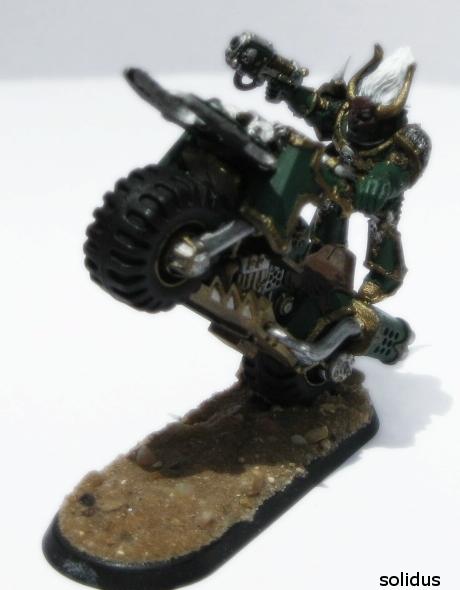
This will be the final segment in discussing a potential, alternate CSM list that is a lot of fun to play and is decently effective outside the realm of Dual Lash lists.
The last topic I wanted to discuss is the math hammer. There are some of you out there who may have read these articles and shook your head going, “yeah right. My ________ shooty army will PEW PEW your right off the board on turn 1.” The only way you are going to believe how much damage a list like this can absorb and dish out is to look at the math hammer and “BELIEVE!” (like in kid’s movie) that it will work.
Don’t I need Marks of Glory so I won’t Run?
First, running isn’t really a bad thing for this list unless you are already below half strength on a unit and therefore likely already out of combat shape. Either way, you can still shoot while you retreat. Further, running back usually nets a safer position from assaults or “decides” for you which units of yours will fall back to hold objectives.
Chance to Fail a Morale Check with a 9 Leadership: 17%. (This means that one in approximately ever 5 you are required to take, you will fail.
Chance to Fail a Morale Check with a 9 Leadership TWICE (for regrouping): 3%. So, unless you are below half strength, you won’t keep falling back.
You aren’t too worried about this in an assault because you really want to run anyways, even if it might kill you. We want to fall back so we can shoot what attacked us.
Seriously, even with a cover save, I’ll blow your Rhinos away!
% Chance a BS 4 S 8 Weapon Stuns, Immobilizes, or Destroys a Rhino with Cover – 11%
% Chance a BS 4 S 9 Weapon Stuns, Immobilizes, or Destroys a Rhino with Cover – 15%
On average, how many Rhinos can 3 Long Fang Packs with 5 Missiles Stun, Immobilize, or Destroy in a Turn? – It takes 6 Rockets to have just a lousy 50% (coin flip) to hurt one Rhino in cover. Given that, expected return from 15 Rockets should be 2 Rhinos. (This is also why you can’t skimp on Rhinos and pay attention to what I was saying about moving up anyways if you lose your ride.)
A Vendetta, firing 3 Twin Linked lascannons only has a 43% chance to stun, immobilize, destroy a Rhino in cover. The expected return for 3 Vendettas is 1 Rhino a turn!
Remember that Stun does not equal destroyed. Remember that your Rhinos can repair themselves, albeit unlikely.
A melta gun with a BS of 4 at POINT BLANK RANGE only has a 28% chance to stun, immobilize, or destroy a Rhino in cover.
Will you play a game where you opponent gets insanely lucky and blows up half your Rhinos? Yes! It will happen. The thing to remember when it does is that this kind of thing happens to every list, not just this one. Also, the most important thing to remember is that for each time this might happen to you, it will happen MORE OFTEN that your opponent doesn’t kill a Rhino at all.
A dead rhino is as good a cover save producer as a live one.
Yeah, but what about Thunder Shield Terminators with 3++ saves?
A single plasma shot has an 18% chance to take down a terminator. A rapid firing plasma gun has a 33% chance to take down a Terminator. One in 3. So, basically, to take out 5 terminators, bring 15 Plasma Guns. That’s a lot!
Yeah, I know. 2 things though. You have 15 plasma gun or some combination of that and melta in this list. Second, 1 Terminator has a 41% chance to die if he charges your units. :P 1 Terminator really isn’t that much of a threat.
Bottom line? Use your Rhinos to block them so they can’t get to you. Tactics over firepower.
But also always keep in mind that for a lot of strong assault units, if you kill 90% of the squad, the remaining 10% probably can’t hurt you anymore. That’s not always the case, but it tends to hold true. Use that knowledge where applicable.
And last but not least, a Plasma gun standing still has a 24 inch range with one shot… much farther than assault ranges.
You can’t really start shooting after 1 turn can you?
12 inches forward. 2 inch disembark. 6 inch move. 12 inch shooting. 12 + 12 + 2 + 6 = 32 inches. Draw a picture!
What if the Rhino stays alive? 12 inch move, TWICE. 2 inch disembark. 12 inch shooting = 38 inches.
No, you can’t outrun a Rhino with guys inside that want to take your lunch money.
In the End
There’s probably more to say, but I think that’s enough for this series. Hopefully I’ve helped you come up with some ideas that may breathe some new life into your CSMs.
I’ll end this series with a list that I would consider to be very efficient.
HQ:
Kharn - 165
Elites:
5 x Chsoen + 3 x Melta + 1 x Plasma - 180
Rhino + Combi-Melta
5 x Chsoen + 3 x Melta + 1 x Plasma - 180
Rhino + Combi-Melta
5 x Chsoen + 3 x Melta + 1 x Plasma - 180
Rhino + Combi-Melta
Troops:
5 x Plague Marines + 2x Plasma - 190
Rhino + Combi-Melta
5 x Plague Marines + 2x Plasma - 190
Rhino + Combi-Melta
5 x CSM + 1 x Melta - 130
Rhino + Combi-Melta
5 x CSM + 1 x Melta - 130
Rhino + Combi-Melta
5 x CSM + 1 x Melta - 130
Rhino + Combi-Melta
Heavy:
5 x havocs + 3 x Plasma + 1 x Melta - 175
Rhino + Combi-Melta
5 x havocs + 3 x Plasma + 1 x Melta - 175
Rhino + Combi-Melta
5 x havocs + 3 x Plasma + 1 x Melta - 175
Rhino + Combi-Melta
Thursday, May 12, 2011
Tactics over Toys and Tidbits

If you ever start to seriously study anything, you’ll find out that our reality is a pretty complex place. What may seem very simple on the surface quickly turns into some pretty difficult stuff. The thing about complexity is, though, that most of what makes something complex is hardly what makes it up at all.
You’ve heard of the butterfly effect? That’s the whole, “a butterfly flaps its wings….” And after a long, complicated chain of events, somehow that butterfly flapping its wings causes a hurricane to smash into the east coast of the US, causing billions in damage. People sometimes refer to this as Chaos theory. More importantly for this article, people also use that to show you just why even the smallest, seemingly inconsequential things matter. It makes us all feel good when we feel like any small action we take could have some sort of giant ripple effect.
The truth is, though, our butterfly flapping its wings was not the sole cause of that hurricane. Thinking that the butterfly was the direct cause, creating some huge, ripple effect, is just not true. The butterfly may have added just that one, last, little bit to the equation that equaled hurricane, but it certainly wasn’t the cause. Much bigger forces were already in play, just waiting on that butterfly to barely tip the scales between nice summer day and disasterous storm. Those bigger forces, be they atmospheric conditions, the tides, air masses, whatever… I’m not a meteorologist, are more like the CAUSE of the hurricane. The butterfly is more like a straw that broke the camel’s back.
When you study non-deterministic systems, meanings “things” in life for which there is no real solution, like predicting which horse wins the next horse race, you will quickly note that there is never just one, solitary variable determining the outcome of an event. There are many! In fact, Chaos theory above, with the butterfly example, truly exists to tell us that we will NEVER know all the small variables that went into something happening. (That’s right, it’s not a story to make you feel better about being an individual snowflake capable of creating enormous ripples in the world.) We may never know that it was a butterfly that was the last straw before the hurricane. What we WILL know is that the biggest forces in play, the atmospheric conditions, were present and a hurricane was likely. For another example, we may never know that it was a special type of grain Horse A was fed that just barely caused him to win, but what we can know is that Horse A is raised and trained by one of the premier horse trainers in the world.
In statistics, when you are faced with analyzing a scenario in which multiple variables are in play, like the creation of a hurricane, it’s often useful to know which of the variables are the strong ones, those that greatly affect the outcome of an event, and the rest, those that barely have any affect at all. You can study these mathematically to arrive at the conclusion that although a butterfly flapping may have contributed to the cause of an event, it’s statistical contribution was only 0.000000001% whereas atmospheric conditions were 95% of the overall contribution. Thus, if you really want to know if a hurricane is going to form, you should really be putting your effort into studying atmospheric conditions rather than insects.
In playing a game like 40K, the same principal should be applied. You should really be focused on the contribution of the biggest variables towards what helps you win a game rather than sweating the small stuff. This is the difference between an arm-chair general and a seasoned player. An arm-chair general focuses on the list. He focuses on how to squeeze optimization out of units, lists, and what have you in the world of “think games” where his reasoning comes from theory-hammer. A seasoned player draws his conclusions from games actually played.
A seasoned player recognizes that things like complete list optimization is generally the smallest variable in play. Why? Well, first, because you never know what you will need till you get there. Tournaments, games, armies, lists, players, and much more all effect “what you need”, and thusly, are all much greater factors than list building. A seasoned player will also tell you that rules usage, or tactics if you prefer, is much more important. Your ability to use the rules is the bigger variable in play over your ability to build a “balanced” list. You are much better off studying tactics and seeking advice on better play than you ever are on seeking advice about what to put in your list. (Indeed, I could argue that proper study of tactics will lead you to be a better list builder, not the other way around.)
This is why people always rattle off, “a good general can win with a bad list.” It’s because rules knowledge is the bigger variable in the system.
It’s also why players who have the time and capability to practice will always be better in the end. Likewise, it’s also why I will never be a great 40k player because I don’t have the time or capacity to practice, mainly because we live in the desert of 40K. I have plenty of time to “list build”, but that won’t mean a thing if the “atmospheric conditions” aren’t there for my list to work.
Another fine example I like to use on this point is that of owning your own bowling ball. What??? You've been bowling before, at least once I hope. You go to the lane, you select a ball from those the lane has available, and you play. Well, if you go bowling a lot, I highly recommend purchasing your own ball. You can get it drilled to fit your fingers, and it will help you get more consistent games. What I do not recommend doing is paying $300 for a professional ball and instead paying $40 for a cheap ball. Why? Because you aren't a good enough bowler for it to make a difference!
I will never be a good enough bowler to warrant a professional ball. I simply do not have the time or capacity to bowl that much because it's PRACTICE that makes you a good bowler, not the ball. I will wield a cheap ball and a professional ball with the exact same skill. A professional bowler will need a professional ball because he has so finely honed his skills that the ball is now actually making a difference.
With 40K, it's not different. Worry more about rules, practice, and game play. Like most, myself included, you will never be able to be part of a group of people who can practice enough 40K that fine tuning your toys and tidbits of information will make any difference. I recommend getting a ball if you play a lot because it helps, (getting a list you like), but beyond that, worrying about if your ball (army) is professional grade is all but meaningless.
My overall point? Study rules and the ways to use them to win games. Don’t sweat, “do I have a good list???” Optimized lists still regularly lose games. There’s tons of evidence to show that.
Subscribe to:
Posts (Atom)